
The Democratization Myth: Why “Good Enough” Is Risky for Creativity
AI has been hailed as creativity’s great equalizer. A magical tool that promises access, efficiency, and endless possibility. With a single prompt, anyone can produce content that looks polished enough to pass.
But after spending years working inside the world of brand strategy, campaigns, and cultural storytelling, I’ve come to a different conclusion:
AI isn’t democratizing creativity. It’s homogenizing it.
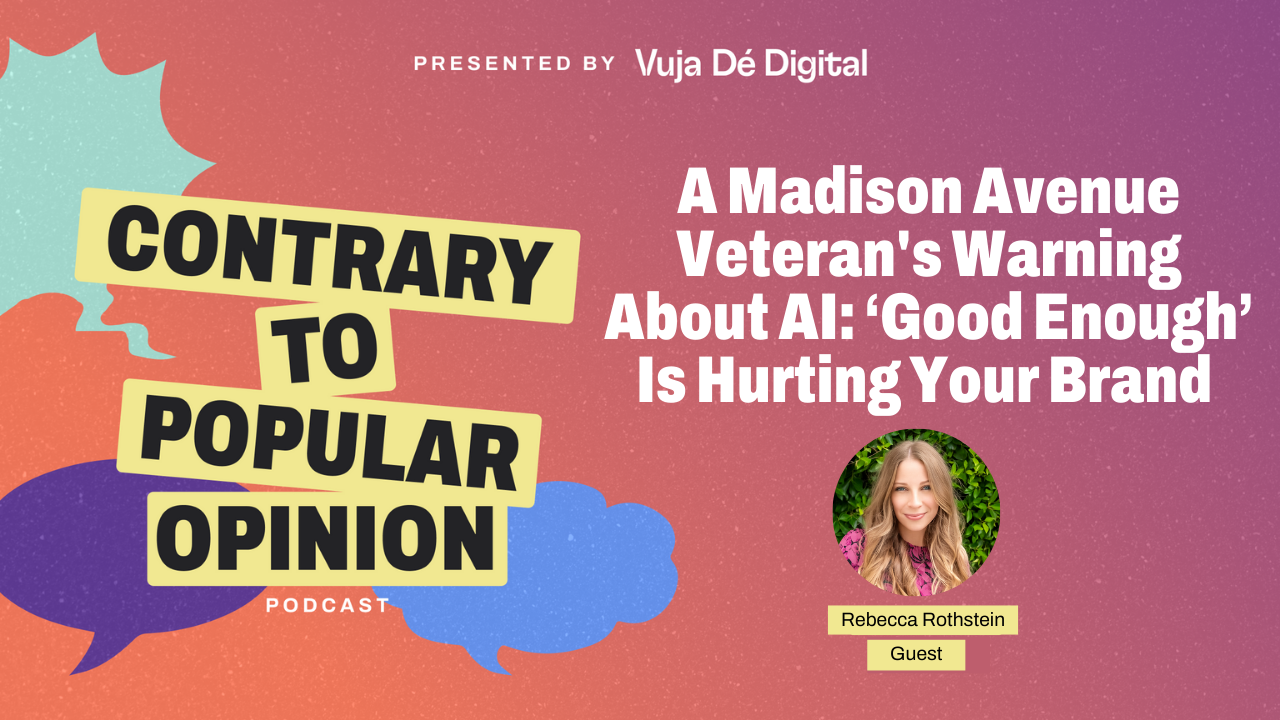
This is the conversation we dove into on the Contrary to Popular Opinion podcast—and one that’s becoming more urgent by the day.
The Illusion of Infinite Creativity
AI can generate ideas instantly. It can produce variations in seconds. But for all that volume, all that speed, there’s a cost no one wants to talk about:
When machines optimize for patterns, everything starts to look—and feel—the same.
Memes, ads, captions, brand identities, scripts… we’re drowning in output, but starving for originality. And “good enough” has quietly become an industry standard.
It’s fast. It’s accessible. It’s fine.
But “fine” is not the future.
“Fine” is how creative industries flatten.
What Machines Still Can’t Steal
Here’s the truth: AI can analyze patterns, but it can’t understand why culture moves the way it does.
It doesn’t feel.
It doesn’t observe the world.
It doesn’t sit in the swirl of the cultural moment.
It can’t tell you why a 110-year-old thermos brand suddenly becomes Gen Z’s latest obsession. It can’t interpret irony, humor, subculture, taste, or timing with the intuition of a human mind that’s been paying attention.
That’s why taste is becoming the most valuable creative currency we have left.
And yes—AI can expedite execution. But it can’t replace the thought behind it.
Not the instinct.
Not the nuance.
Not the emotional intelligence that makes work resonate.
The Junior Talent Time Bomb
The part of this conversation that scares me most?
Entry-level creative work is disappearing.
Traditionally, that’s where people learn:
by doing, failing, iterating, presenting, revising, and experiencing the stakes of real work.
If machines take over the foundational jobs, where do the next creative directors come from?
Who trains them?
Where do they practice judgment?
How do they develop taste if they’re never given the opportunity to make, experiment, stumble, and grow?
We’re building an experience gap, and the industry doesn’t yet understand how damaging that will be.
Are We Prompt Engineers or Artists?
This question haunts a lot of creatives right now.
AI is a tool. A powerful one.
But the mistake is treating it like a replacement for thinking.
Prompting is not creative direction.
Pattern recognition is not insight.
Output is not originality.
The work still needs humans who feel something.
Humans who interpret culture.
Humans who ask why, not just “what else?”
The future belongs to people who use AI strategically—without outsourcing their taste or intuition.
The Short of it
This is the part of the conversation that resonated most deeply with listeners:
In a world drowning in AI-generated content, exceptional human creativity becomes a survival strategy.
Not a luxury.
Not a “nice to have.”
A necessity.
The work that stands out tomorrow will be the work infused with point of view, emotion, humor, cultural literacy, and lived experience—things machines cannot replicate.
The shortcut era doesn’t eliminate craft.
It just magnifies the difference between creators who think, and creators who don’t.
Want the Full Conversation?
These ideas—and many more—came to life in my conversation on Contrary to Popular Opinion.
We covered the myth of democratization, the future of junior talent, the danger of “good enough,” and the creative advantages machines will never touch.
You can listen on:
Spotify and YouTube
And yes—my glasses absolutely took up half the screen.
Consider it their podcast debut.